Showing posts with label Board review. Show all posts

Monday, April 14, 2014

Amundson 12'6" TR: Water Review

I finally got my new Amundson out on the water. It was one of those strange spring days we get this time of year in New York. The air was 78 degrees and the water was 44 F. I went back and forth about what wet suit to wear, and finally settled on my light 2.5 MM farmer john. Anything else would have been a portable sauna, and I figured if I fell, I'd be okay. I wore my PFD just to be sure, although I think PFDs are mandatory anyway until May.

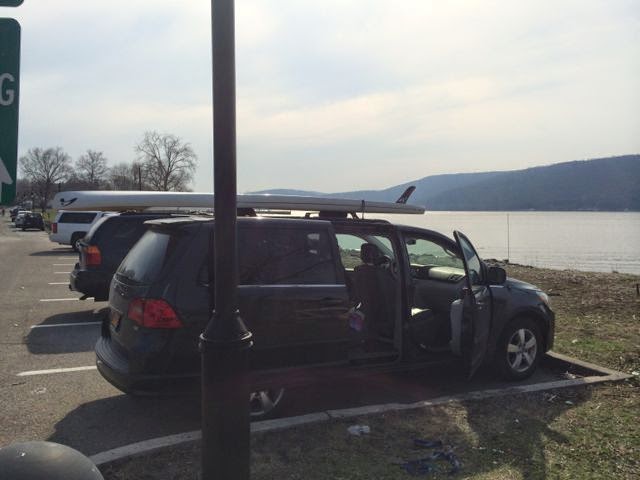
My board bag hasn't arrived yet, so I loaded the board on top of my wife's VW Routan. Down to Peekskill waterfront I went. The conditions looked placid, but that was deceiving. This would also be my first time with my new KeNalu xTuf paddle.

As I got on the water, I got hot with about a 10 mph southerly in my face. Not the most fun conditions, but it was a good test for the board. The straight nose punched through the light chop pretty easily with little board slap. I went on my standard loop, which is anywhere from 3-4 miles. Around  my first turn and my back was to the waves. This was when the flat bottom of the board became very obvious. As the tiny waves came from behind, I felt the board try to run with them on the bottom. I buried the nose a bunch of times, but that didn't affect the ride much. I think the extra buoyancy in the front had something to do with that too.

My KeNalu has been cut longer than my older paddles, and wow was I feeling that. There was a lot more load on my upper shoulders near my collarbone. I also realized that I had been crouching a lot with my older paddle to get it buried in the water. Now I could stand more upright! That was very nice! Plus, the paddle itself was a feather. It was weird paddling something so light. A couple other things I noticed was the funny, grippy texture on the shaft. My fingers made a funny sound as I switched the paddle from side to side.

Two things to say about the upwind paddling. The first is that the chop didn't bother the board that much. The second was that I could feel the smaller volume and smaller size of the board in decreased glide. I had to be more on my game than on a fourteen footer, especially since for about half a mile I was getting pushed up against a rocky embankment. Absolutely no relaxing or I'd get knocked up against the rocks. The nose also got knocked from side to side a bit, although I was impressed by the stability of the board when I had to paddle with the chop hitting me at ninety degrees. I figured the flat bottom would increase the chances of the board getting thrown, but it felt stable, even when getting rocked side to side.

I can definitely live with this board. It didn't knock my socks off with anything, but it behaved itself well in lousy conditions. On a rough 3.5 mile stretch I averaged 2.7 mph, getting up to 4.5 mph in the downwind section. I'm looking forwards to testing it out in flat water conditions, which happens rarely to never on the Hudson.

Next time I'm going to use that Gladiator fin. It seems stupid now to have gone out without it, although I wanted a feel of the stock fin.


Amundson 12'6": Land Review

So, I finally replaced my Exocet Eggshell with a recommendation from Jim Karabasz, an Amundson 12'6" TR. I'm going to give my first impressions of the board, then get it out on the water in the next few days. The water is still about 40ºF and the days have been pretty windy, so getting out is kind of dicey.

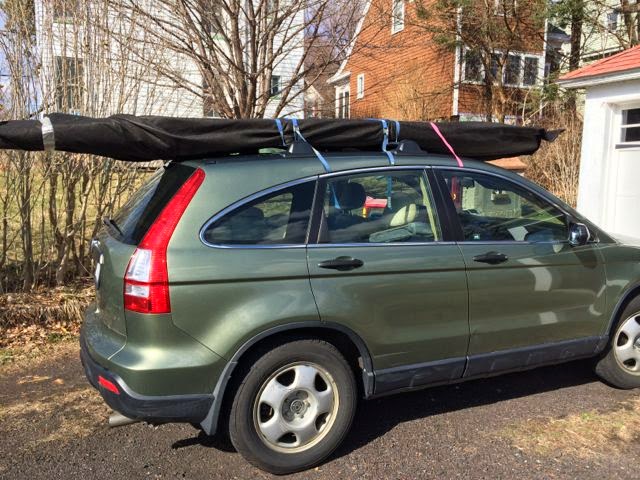
The construction — something I was very concerned about — looks solid. Jim has assured me that this is a very solid boar that can take a couple of knocks. The sales material calls it “Rhino-Lite” construction. What made me choose this one over the Bic Wing was the fact that he described this is much more repairable than the Bic. I'm still going to baby the hell out of it, but it's also good that it can be repaired. It feels relatively solid, although time and the Hudson River will tell. The bag hadn't arrived yet, so before transporting the board, I slid it inside the big board sock which was shipped with my Eggshell. (I still don't know it's purpose. It's too short for a fourteen-footer and doesn't fit well around anything.)

It's strange going from a 14 footer to a 12'6". This board is obviously smaller than that Marlin but it's also thinner. At 239 liters, this model is over 100 liters smaller than what I'm used to. I'm not terribly upset about this. A fourteen-footer can be a whale of a board, and it's nice to have something smaller to shlep around.

The board is relatively flat with a vertical nose. It seems kind of “surfboardy”. The rails are rounded hear the nose but get pretty sharp about halfway back. If I wasn't looking at the nose, from the bottom it looks a lot like a big wave board. The rear is square. My guess is this will be a very good flat water board with some ability in chop.

The top is a nice bright yellow. This is a good color for a place with a lot of board traffic. Yellow is a really easy color to spot, unlike red or blue, and I'm glad about that. The styling isn't too bad. Like most Amundsons I've seen (my wife has an old 11'3"), the styling is kind of modest but tasteful.

There's a ridge extending from the nose almost to the deck pad, which I assume is to put a little extra volume in the nose. The deck is slightly recessed with a plain grey pad. In front of the deck are four attachment points for bungies or a bag. I wish it had more, but four is probably enough for 95% of what I do. There's a threaded point for a windsurf mast or GoPro right in front of the handle and a vent plug behind it. There's a sight concave to the decks which goes back to the tail, letting water drain easily.

The handle is that new style which goes into the board an extends underneath the board a little. I like that a lot. What a difference that small thing makes with carrying a board! All SUPs need to have this.

This seems like a solid, medium-sized board. I'm looking forwards to taking it out.


Sunday, July 28, 2013

Exocet Marlin AST 14' on the Land

Note: I wrote this initially for the StandupZone form, www.standupzone.com, where I post as Ichabod Spoonbill. As well, while this board is a good shape, I have found it's construction unsuitable for where I paddle.


__________________________________________________________

This is my new Exocet Marlin 14’. I had gone through a year-long search for a new flatwater board to replace the NSP 11’ that I’ve been paddling. I outgrew that board on the flats over a year ago, but unfortunately a new board wasn’t going to come soon. I’m a public school teacher so it’s hard to slip a new board into the budget on a regular basis.


I needed a board for the Hudson River. The Hudson is an odd place to paddle. It’s brackish for much of it’s length and very rocky. Any river board was going to have to be tough. The board was also going to have to be good in chop. The tides plus current plus winds can create some weird local conditions. It can be perfectly flat, then 100 yards away you have foot-high chop. The winds can also be very variable. I’ve seen five mph go close to twenty in minutes. It also had to have tie-downs for distance paddling and just carrying gear.


I went around with a few ideas, originally thinking about a 12’6” board, mostly because of the price, until I saw the Exocet Marlin. At $1,299 the price was right and very competitive. It seemed to fit all of my criteria too. Plus, it was made by Exocet, which is a company I like. I come from a windsurfing background, and my remaining two boards are Exocets. I’m especially fond of my Exocet Kona One, which is a great, tough, versatile longboard, the perfect board for the variable Hudson.

The Marlin comes in a carbon as well as an AST version. I went with the AST version -- mostly for price -- but there was also the durability factor. I don’t mind a little extra weight if that means extra strength.

I’m going to talk about the board with little experience with boards of this type. If I miss something or are inaccurate about a description, that’s where I’m coming from. As well, this is a virgin, never-ridden board, so I can’t talk about paddling it yet. That will come, but even when I do discuss the board on the water, I won’t have the experience to compare it to other boards of this type.

The board has a very nice shape. Looking from the top, it’s quite concave at the nose but that shape gradually changes to be completely convex at the tail. I assume this is to get the rider lower on the board but to also allow drainage at the tail. The deck is padded with a waffle pattern which seems fine for feet, giving maybe a little extra friction than a flat pad. That waffle pattern is probably good for drainage too.


The Marlin has a standard handle plus it’s tapped for a windsurfing mast or camera mount, which is nice. I could actually use one of my sails on it. The tie-downs are integrated into the board and there are fourteen of them, nine in the front and five in the rear. The rear tie-downs are nice, because I could mount a kayak seat there and take my nine year-old son on some of my longer expeditions. I’m going to be teaching him  how to kayak this year, so this might be a great way to give him a chance to learn paddling under my supervision. (Note to self: some rail tape might be a smart purchase.) The tie downs in front are enough for a bag plus some netting, or a PFD.


The nose is rounded with some rocker. I don’t know enough to tell whether that’s a lot or not, but there’s a definite curve to the board in general. It looks like it will pierce through chop pretty effectively, at least compared to the all-around board I’m used to. The bottom is pretty flat and the rails are reasonably sharp.


I rather like the green color. I would have preferred the all-green look of the carbon board, but that’s the choice I made. There’s a pretty peach-colored hibiscus pattern near the nose, reminding me of the pattern on my Kona One. The specs of the board are printed below the flowers. Above the model name “Marlin” is a... flying fish. Why is it not a Marlin since that is the name of the board? Flying fish are certainly pretty, but it seems a bit odd to have one on a board named for a completely different species, one that actually preys on flying fish! And it’s not like a marlin is an ugly fish either; they’re quite beautiful, so why not put the right fish on the board? Same with the wing pattern on the footpad. What does that have to do with the board’s name?


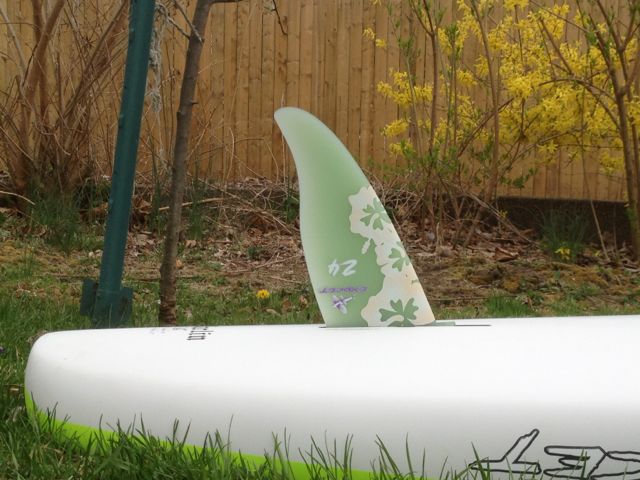
The fin is an Exocet model, and it seems a little small for such a big flatwater board. I made a comparison shot with two other surf-style fins, and it’s the smallest of the three. It’s also very translucent. The trailing edge almost seems to disappear. Those of you with more experience than myself with fins can tell me how well-matched this fin is to a 14’ board.


The board came with two accessories: a carbon Epic paddle and a long black “sock”. The Epic paddle seems like a standard low-end paddle. It felt an ounce or two lighter than my workhorse Kialoa Pupu. I wasn’t sure what to make of the sock. It’s a little short for the Marlin’s fourteen feet, and it’s a strange shape. I wonder if it was made for something else. Is the odd shape to accommodate the board’s rocker? I also got an Epic bag to protect the board on the road.


Friday, July 19, 2013

Board Review: NSP 12' Cruiser

My friend Jerry Patterson called me the other day. He owns the only local SUP business in the mid-Hudson River area called Standup Motion (http://www.standupmotion.net) and does a good business giving SUP lessons as well as renting boards and selling board. He asked me if I wanted to do some board reviews for this blog, which sounded like a lot of fun. I met him at Oceloa Lake in Jefferson Valley where he's leased a put-in. There he had the new NSP 12' Touring SUP in blue ready for me to check out.

I was a little skeptical about pure touring SUPs. A twelve-footer is a board clearly designed to not race. It could technically fit in the 12'6" class, but it would be at a disadvantage without those extra six inches. Not that I race, but it seems like NSP was making a deliberate statement with the length of this board.

Let's start with the NSP blurb: The 12'0 Cruiser is new for 2013. It is designed as the board that can do it all. Stable, easy to use, great for fishing, training, family and fun! The new cruiser was designed with the perfect width and volume to get you started and off and cruising quickly on flat water or the ocean. Last years 12'0 was very popular with hire centers and the new design takes the usability to the next level.”


My first impressions were that the board is very wide, and it is at over 33". The fin is also a vertical, non-surf-style fin. I'm told this fins of this style creates more drag than a more swept-back shape, but I've yet to really test that. It's also very flat with a little rocker in the nose.

The nose has more of a ship-style point than my Exocet Marlin 14, which is more kayak shaped.

Looking at the deck, it's very clear this board is designed for cruising. It's wide in the front for extra stability. There are also fourteen tie-downs in the front! (Count them.) I love a board with tie-downs. They give you that extra flexibility when cruising. You can put all sorts of things on them like rigging, or a net, or a deck bag. NSP seems to understand that. The one thing missing was a threaded Go-Pro mount. There is a tie-down where the mount should be, but it's clearly for rigging or maybe the forward mounting of a leash.


Time to get the board in the water. I lifted it by the handle, which is the new style with recesses into the board. It was the first time I tried it and I never wanted to go back. Wow, you get such a better grip with it! I remembered all those time shlepping my NSP 11' surfboard up and down the beach by the handle, my fingers cramping painfully. This little change in the handle would have made all the difference. The 12' Cruiser is also very light. The website says it's fourteen pounds, which seems a bit light, but it was definitely easy to carry.


Time to paddle this puppy. I first played with it in the water. The board was very stable. The extra width meant I had to bring the paddle out a little further than I was used to, but I got used to it quickly. It tracked well, which perhaps could be improved upon with a different fin. It turned easily with sweep and cross-bow turns. The relatively short length and extra width made it an easy board to pivot-turn.


Not all of my pivot turns are successful!

After playing around for a while, I took the board on a GPS run around lovely Lake Oceola. I used MotionX-GPS on my iPhone 4S in a waterproof pouch. I kept the phone in the waist bag with inflatable PFD. The water was flat, almost glassy and there was no wind. The water was fresh. Results:


Name:Track 015
Date:Jul 18, 2013 7:19 pm
Map:
(valid until Jan 15, 2014)
View on Map
Distance:0.87 miles
Elapsed Time:11:28.0
Avg Speed:4.5 mph
Max Speed:11.4 mph
Avg Pace:13' 11" per mile
Min Altitude:411 ft
Max Altitude:413 ft
Start Time:2013-07-18T23:19:58Z
Start Location:
Latitude:41º 20' 05" N
Longitude:73º 47' 55" W
End Location:
Latitude:41º 20' 05" N
Longitude:73º 47' 56" W


4.5 mph is a pretty respectable speed for this board, especially on fresh water. Fresh water is a little slower than salt because it floats the board less, so more of the board is exposed to the water creating more drag. I'm not sure where that 11.4 mph reading comes from. It doesn't show up on the stats for the run, so it may be an artifact or I may have gone that speed very briefly as I pushed myself onto it. Either way, it probably isn't enough to skew the results more than a tiny bit.

One of the neat surprises was the lovely bow wave the board made. When I got it up to speed, maybe 3.5 mph, the water would curl up past the nose in a pretty little arc. At faster speeds the water would get higher than the board and trickle onto the face. This was a little distracting — I ended up pushing my speed just to see how high I could get the bow wave to go. I don't know if this was intentional or not, but I liked it.

After the timed run I paddled the board in a few more casual laps around the lake, chatting with Jerry and Ivan, another SUP buddy. That was even more fun than the timed run. this board seemed to like being paddled casually. It was great platform to just enjoy being on the water. My guess too was that this was a board more at home in flatwater conditions. It might get tossed around a little bit in chop because of the lack of rocker, but the target paddler for this board probably would be going out in conditions like that, as opposed to crazier paddlers like, say, me.

By the end of the evening I have to say I was sold on this board. Who needs to race, or surf? If you just want a board just for flat water, this NSP 12' Cruiser seemed like the perfect platform. A bigger person might find it a bit small, and even tended to sink the nose when I stood forward of the handle while paddling, but for people under 200 pounds, this is a great choice. The light weight is a plus for anyone with not a lot of upper-arm strength, although spending a lot of time on a SUP tends to fix that. It's quick and easy to stand on.

Is this the ultimate SUP? No, but it's an excellent SUP, well suited for touring, paddling, and seeing the scenery. For the person who just wants a flatwater SUP to do all these things and isn't concerned with racing or top-end performance, what's not to like?